6 October 2026
Best Answer Engine Optimization Tool for AI Products (2026)
What’s the best answer engine optimization tool for AI products? See 10 options, 2026 pricing, and when you need monitoring vs. execution. Start here.
Best Answer Engine Optimization Tool for AI Products (2026)
TL;DR
Most AEO tools only monitor whether AI engines mention your brand. They don’t fix why you’re invisible. For AI product companies, the real question isn’t which dashboard to buy, it’s whether you need monitoring, execution, or both. SparkToro’s research shows that individual rank positions in AI answers are noise, but visibility percentage over many runs is reliable. The best approach combines a monitoring tool with continuous content and architecture work. This guide breaks down 10 options across monitoring platforms, legacy SEO add-ons, and full-service execution, with real pricing and honest limitations for each.
Why AI Product Companies Can’t Ignore Answer Engine Optimization
Half of B2B software buyers now start their purchasing journey inside an AI chatbot rather than on Google, according to a G2 survey of over 1,000 buyers. That number grew 71% in just four months.
Think about what that means for AI product companies specifically. When a buyer asks ChatGPT “what’s the best AI analytics platform?” or “top AI writing tools for enterprises,” the answer shapes their shortlist before they ever visit a comparison site. AI Overviews now appear in roughly half of all Google searches. ChatGPT has surpassed 900 million weekly active users.
Category positioning in AI answers tends to cement early. Brands absent when it settles face a structurally more expensive path back in. For AI products competing in fast-moving categories, this creates genuine urgency. As one startup founder wrote on Substack: “We’re already seeing 15–20% of site visits for some startups originate from AI-powered recommendations.” The same founder admitted, “Nobody has the full playbook yet.”
That honesty matters. The AEO tool market is full of bold promises and thin evidence. This guide cuts through both.
Before diving into specific tools, you can run a free AI visibility scan to see where your product currently stands across major AI engines.
Monitoring vs. Execution: The Gap Most Listicles Won’t Tell You About
Every competing article about the best answer engine optimization tool for AI products focuses exclusively on SaaS dashboards. That’s a problem, because dashboards don’t get you cited.
The AEO market breaks into four layers:
| Layer | What It Does | Who Provides It |
|---|---|---|
| Monitoring | Tracks if and how you appear in AI answers | Tools (Profound, Peec, Otterly) |
| Content optimization | Restructures pages so AI can extract answers | Some tools; mostly agencies |
| Technical architecture | Schema, crawlability, llms.txt, semantic structure | Agencies and in-house devs |
| Continuous execution | Ongoing rewrites, publishing, monitoring loops | Almost exclusively agencies |
Most AEO “tools” live in the monitoring layer only. A managed-service analysis from Discovered Labs put it bluntly: platforms like Profound, Peec, and Otterly “diagnose the problem but don’t fix it.”
Practitioners on industry forums echo this frustration. As one AEO consultant shared: “Brands are frustrated by tools promising AI citation tracking but delivering noise, not actionable signal. I consistently see issues with limited LLM coverage, inaccurate API-based tracking, and inconsistent AI recommendations.”
The SparkToro Problem Every AEO Buyer Should Know
SparkToro’s 2026 research found that AI tools produce different brand recommendation lists more than 99% of the time when given the same prompt. Fewer than 1 in 1,000 runs returned the same brands in the same order.
Rand Fishkin’s conclusion: “AI rank tracking is inherently unreliable” at the individual-query level.
But here’s the nuance. When the SparkToro team looked across hundreds of runs for the same intent, the top brands in each category appeared in 55% to 77% of responses, regardless of how the prompt was phrased. Aggregate visibility percentage holds up. Single-run position data is noise.
This means any tool you choose should measure visibility frequency across many runs, not report a single “rank.” And it means the real competitive advantage comes from the underlying content and technical architecture that makes AI models consistently pull from your site. For a deeper look at how this architecture works, see our generative engine optimization guide.
At-a-Glance Comparison Table
| Tool/Service | Type | Starting Price | Engines Tracked | Best For | Key Limitation |
|---|---|---|---|---|---|
| Vardha Tech | Full-service execution | $369/mo | ChatGPT, Gemini, Perplexity, Claude, AI Overviews | AI product companies wanting execution, not dashboards | Not self-serve SaaS |
| Profound | Enterprise monitoring | $399/mo (real entry) | ChatGPT, Gemini, Perplexity, Claude, AI Overviews | Fortune 500 brands with large budgets | 48% above market average price |
| Scrunch AI | Full-stack platform | ~$300/mo | Multi-LLM | Teams needing monitoring + GA4 integration | Acquired by Sitecore; future roadmap uncertain |
| Peec AI | Mid-market analytics | ~$95/mo | Multiple LLMs | Growth-stage companies wanting clean dashboards | Monitoring-focused; limited execution |
| Otterly.ai | Budget monitoring | $29/mo | 6 engines (3 included) | Bootstrap startups tracking basic visibility | Extra engines cost extra; expensive at scale |
| Semrush AI Toolkit | Legacy SEO add-on | $165/mo | Major LLMs | Teams already paying for Semrush | Shallowest AEO features among dedicated tools |
| Ahrefs Brand Radar | Legacy SEO add-on | $699/mo (with sub) | AI indexes | Teams already on Ahrefs Advanced+ | Out of reach without existing subscription |
| HubSpot AEO | Budget entry | $50/mo | 3 engines | HubSpot users wanting basic tracking | Only 3 engines; very limited scope |
| AirOps | Content workflow | Custom pricing | Varies | Teams needing AI-driven content pipelines | Not a pure AEO monitoring tool |
| SE Ranking | Free checker | Free (5/day) | 5 engines | Quick one-off visibility checks | No ongoing monitoring at free tier |
Most entry tiers in this category land between $1.25 and $4.76 per tracked prompt, and several cap you at 15 to 25 prompts per month. Keep that per-prompt cost in mind when comparing sticker prices.
The 10 Best Answer Engine Optimization Tools and Services for AI Products
1. Vardha Tech AI Search Architecture
Best for: Mid-market AI product companies that want full-service execution, not another dashboard.
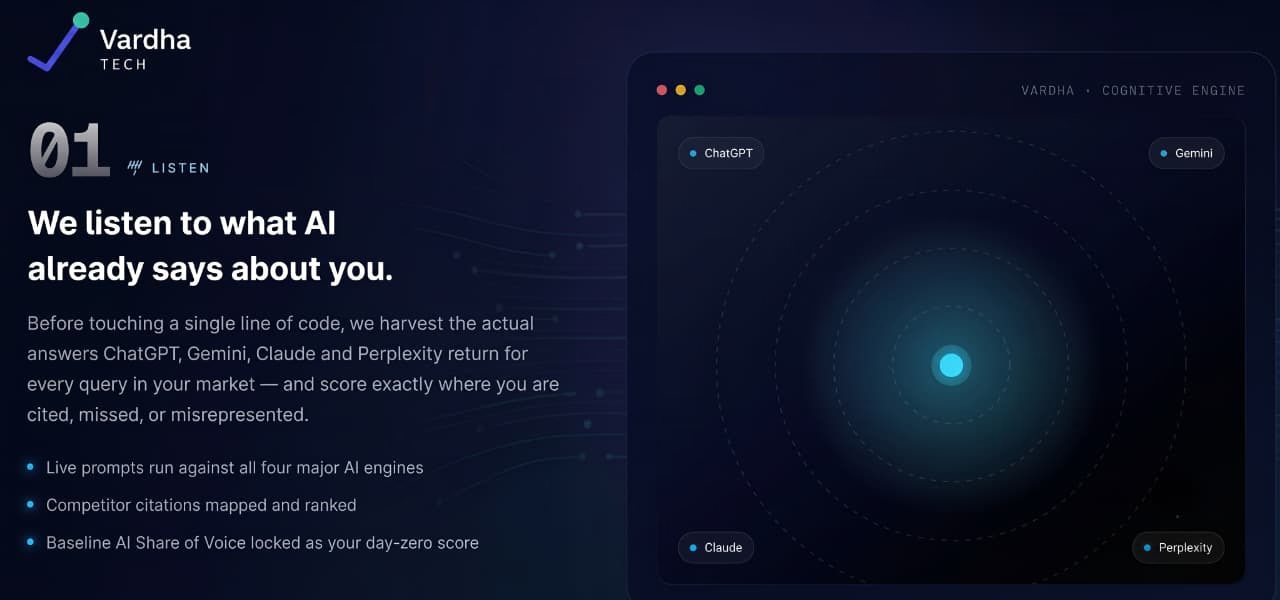
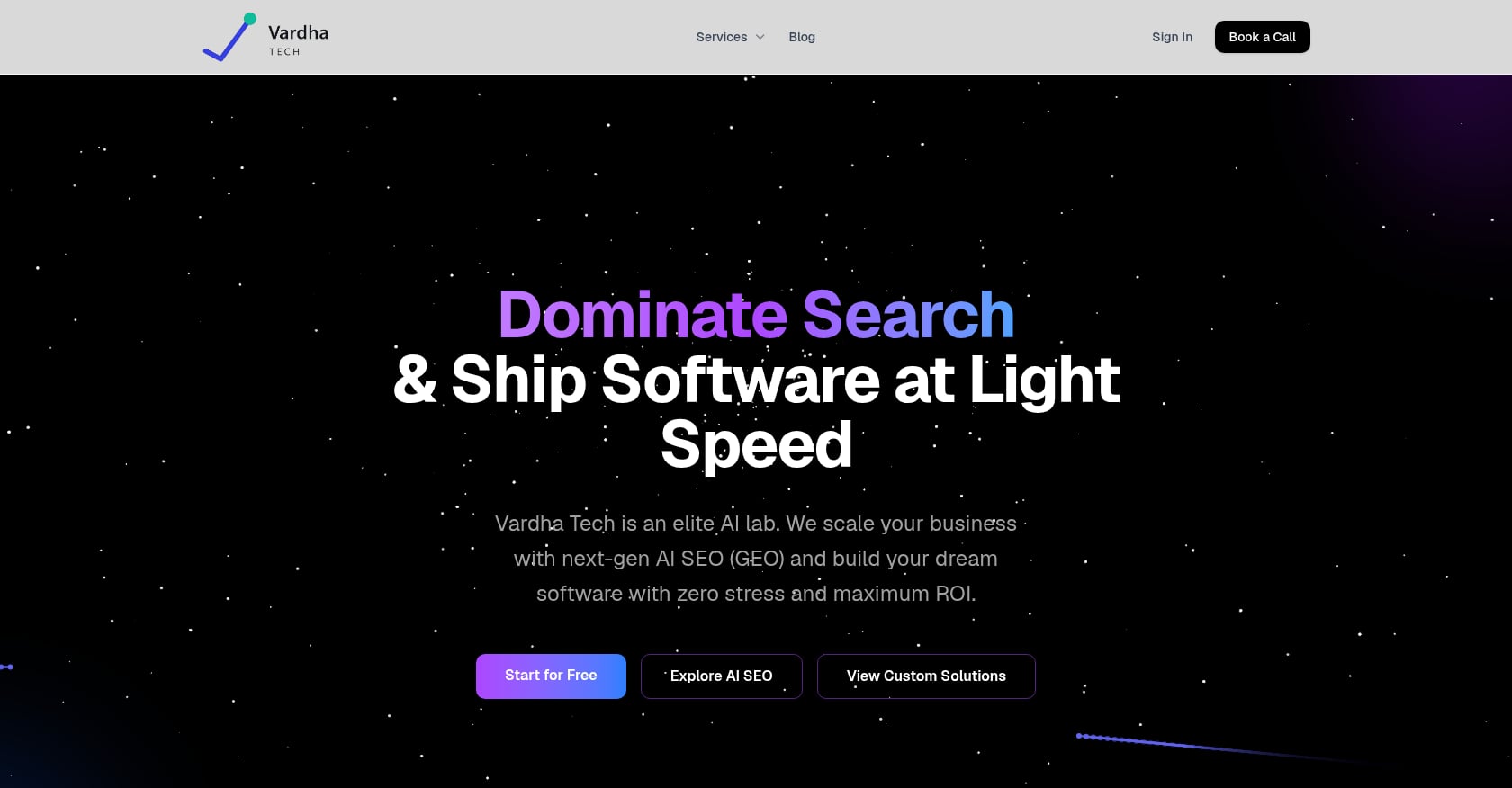
Vardha Tech operates as an AI-powered GEO and AEO agency that combines monitoring with continuous content creation, technical architecture, and optimization. The distinction matters: instead of showing you a chart of where you’re invisible, the service works to fix the underlying reasons.
Pricing:
- Starter: $369/month (8 pages/month, AI citation audit, optimization and keyword research)
- Scaling: $889/month (18+ pages/month, technical fixes, continuous rewrites)
- Master: From $1,989/month (dedicated strategist, priority support, custom architecture)
Key features:
- Covers ChatGPT, Gemini, Perplexity, Claude, and Google AI Overviews
- LLM-native site architecture including JSON-LD, semantic schema, and llms.txt implementation
- Autonomous content pipeline that creates, rewrites, and iterates until pages get cited
- Predictive keyword and intent mapping for questions buyers actually ask AI engines
- Private AI dashboard with live visibility metrics
Tradeoffs:
- Not a self-serve SaaS tool. You’re working with a team, not clicking buttons. For companies without in-house GEO expertise, this is the point.
- Limited slots model means potential onboarding queues
- No guarantees on specific citation placements (no honest vendor can guarantee this given third-party algorithm volatility)
Why it fits AI products: When someone asks an AI engine “what’s the best AI tool for [your category],” the answer depends on your content structure, schema markup, third-party corroboration, and how extractable your key claims are. A monitoring tool tells you the answer didn’t include you. Vardha Tech’s approach builds the architecture so it does.
To see your current standing, you can create a free account and run an AI visibility scan before committing to anything.
2. Profound
Best for: Enterprise teams (Fortune 500) that need the deepest monitoring analytics and have budget to match.
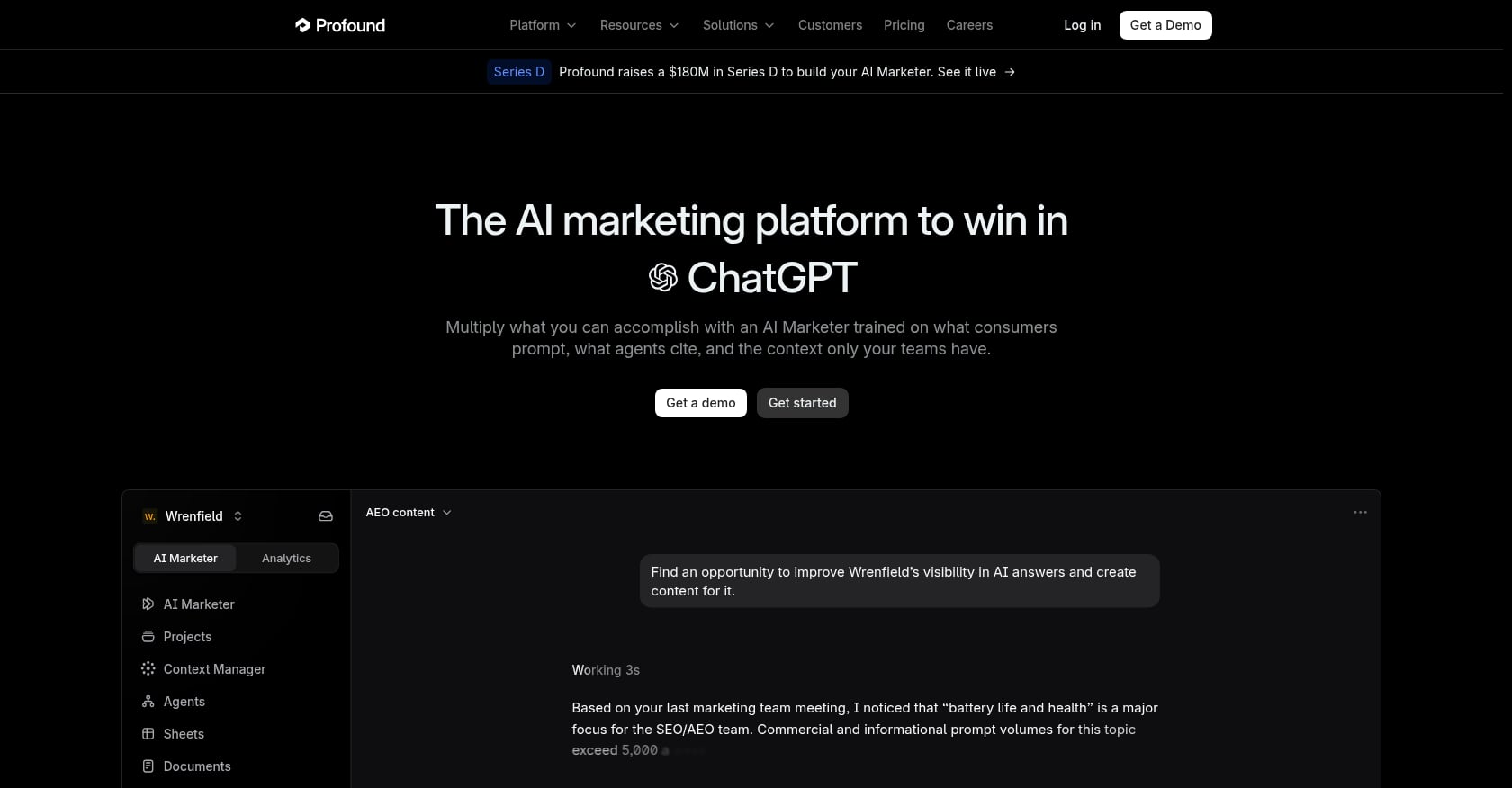
Profound is the category leader by funding ($155M raised, $1B valuation) and brand recognition. It was built for AEO from the start rather than retrofitted from an SEO tool.
Pricing:
- Starter: $99/month (ChatGPT only, single user, essentially a trial)
- Lite: $499/month (the real product)
- Enterprise: Custom pricing
Key features:
- Daily monitoring across top LLMs
- Competitive benchmarking and share-of-voice tracking
- Deep analytics on prompt patterns and citation sources
- Purpose-built for AEO, not a bolt-on
Tradeoffs:
- A 2026 Arvow analysis found Profound’s $499 Lite tier is 48% above the AI visibility tool market average of $337/month
- The $99 Starter plan is ChatGPT-only with a single-user limit, making it more demo than product
- Monitoring only. Does not create or optimize content for you.
- The 5x price premium over mid-market alternatives raises the question of whether the additional analytics justify the cost for growth-stage companies
Practitioner perspective: Multiple managed-service providers describe Profound as delivering “enterprise-grade depth” but note it diagnoses problems without providing the execution layer to solve them.
3. Scrunch AI
Best for: Teams needing the most complete single-platform experience with both monitoring and content auditing.
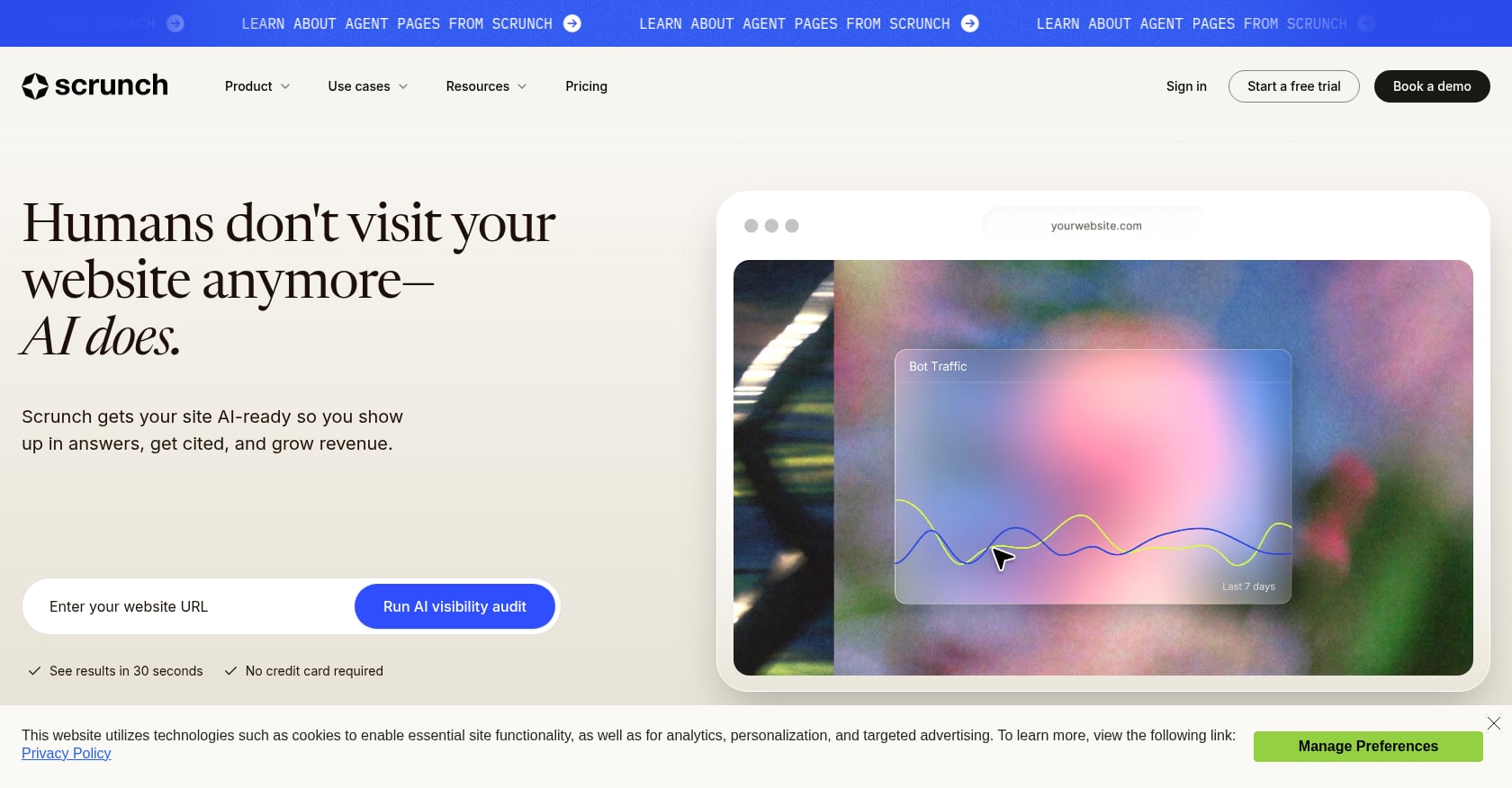
Scrunch AI is the only platform that pairs multi-LLM monitoring and analytics with auditing, optimization recommendations, and AI content delivery, backed by a 4.6/5 G2 rating. It was acquired by Sitecore in June 2026.
Pricing:
- Starting at approximately $300/month
Key features:
- GA4 integration connecting AI citations directly to website behavior and conversions
- Multi-LLM monitoring and analytics
- Content auditing and optimization recommendations
- AI content delivery capabilities
Tradeoffs:
- Sitecore acquisition introduces uncertainty about independent roadmap
- $300/month entry point is mid-to-high for teams still validating AEO ROI
- Despite being “full-stack,” the content optimization is recommendations, not done-for-you execution
4. Peec AI
Best for: Growth-stage companies wanting clean analytics without enterprise pricing.
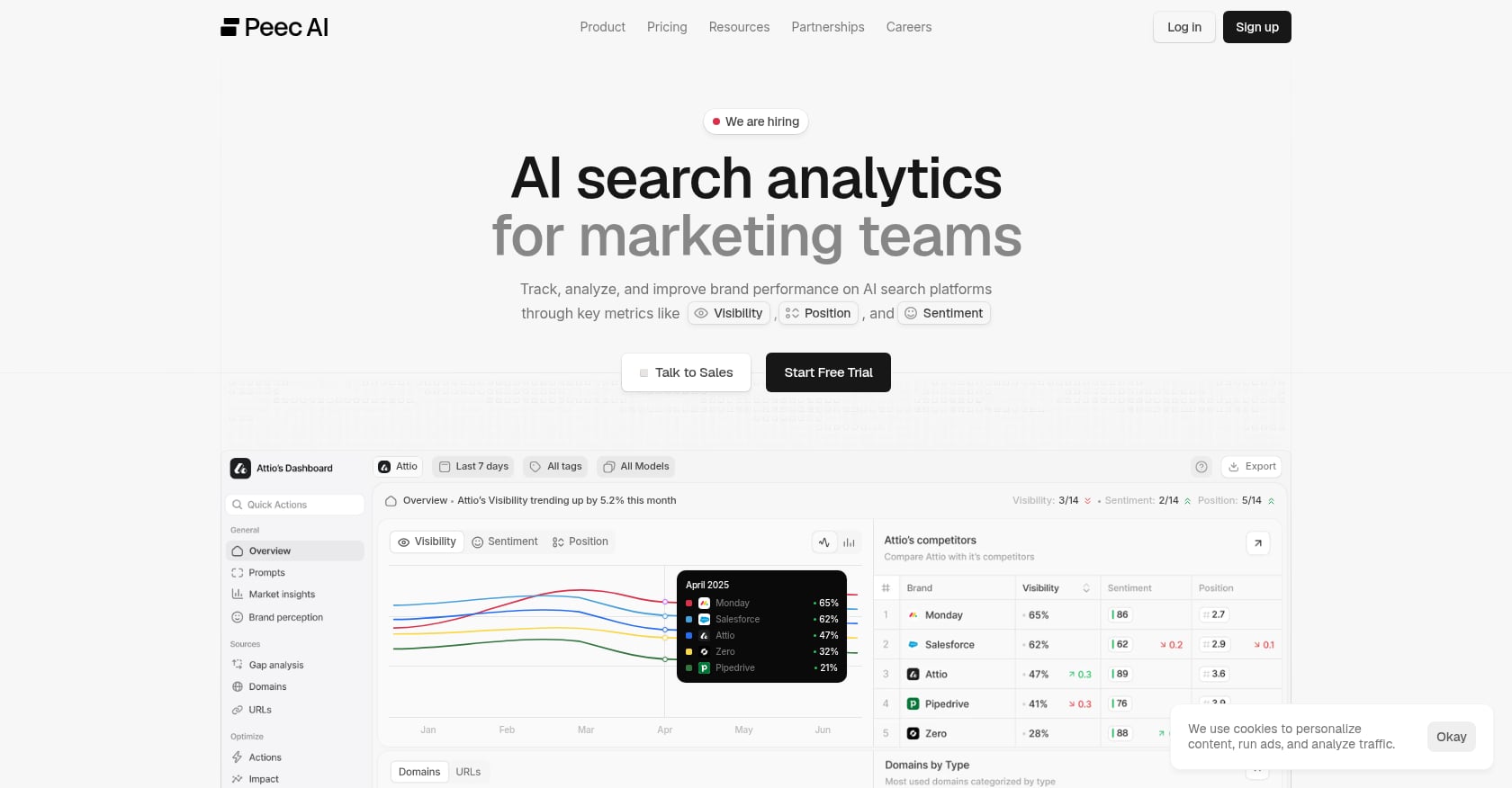
Peec AI has raised $29M and hit $4M+ ARR in ten months, signaling strong product-market fit. Practitioners on Reddit and industry forums frequently note that Peec gives most teams “80% of the value at a fraction of the cost” compared to Profound.
Pricing:
- Starting at approximately $95/month
- Scales to $495/month
- 7-day free trial available
Key features:
- Clean dashboards focused on actionable visibility data
- Multi-LLM tracking
- Competitive analysis
- Quick setup
Tradeoffs:
- Primarily a monitoring and analytics tool, not an execution platform
- Feature depth is shallower than Profound at the enterprise level
- Limited content optimization capabilities
5. Otterly.ai
Best for: Bootstrap startups and small teams that need basic AI visibility tracking on a tight budget.
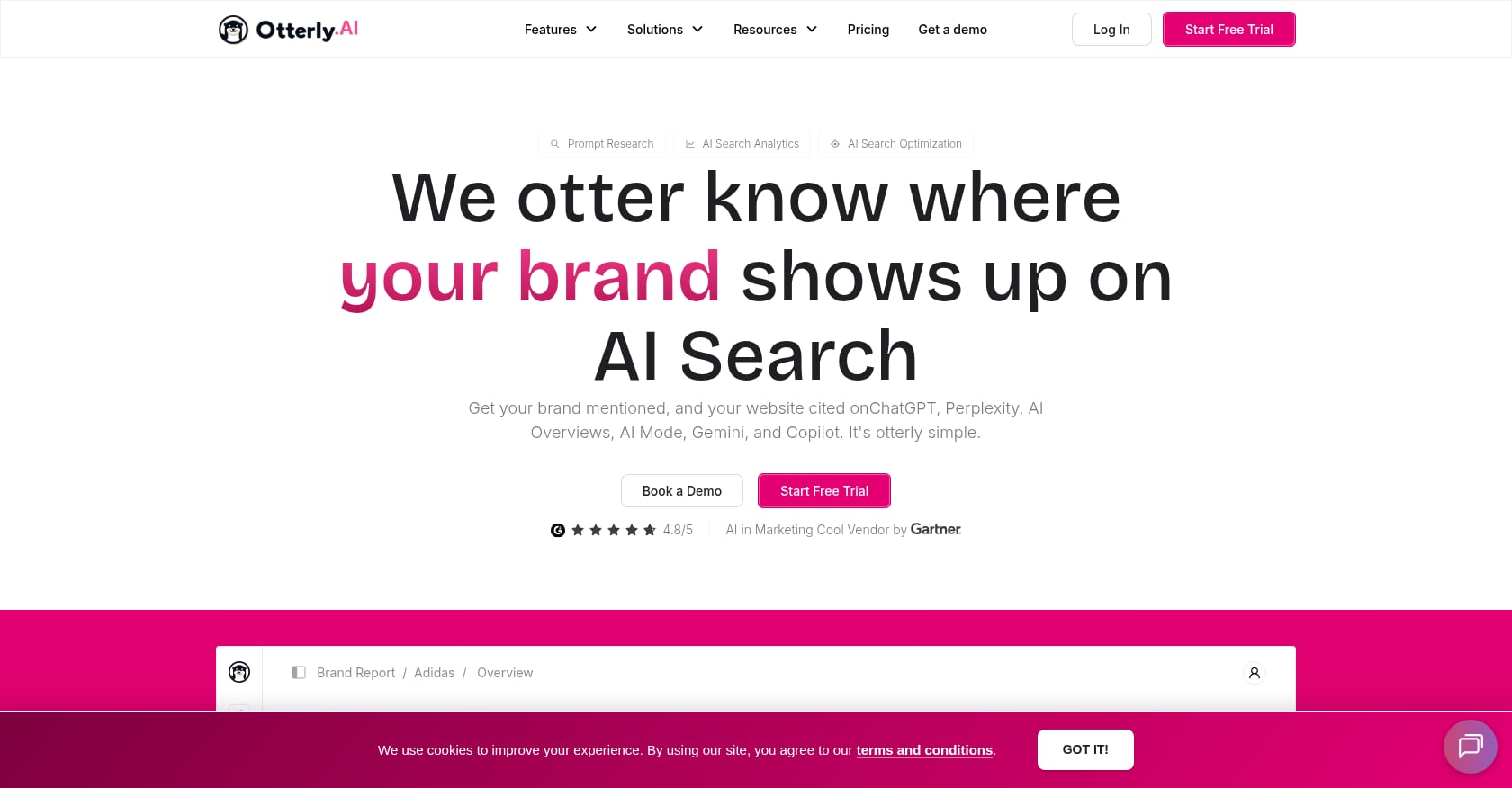
Otterly publishes the most transparent pricing in the category, which earns trust even when the numbers reveal limitations.
Pricing:
- $29/month for 15 search prompts
- $189/month for 100 prompts
- $489/month for 400 prompts
Key features:
- Covers up to 6 AI engines
- Straightforward prompt-based monitoring
- Clear pricing with no hidden tiers
Tradeoffs:
- Prompt-based pricing gets expensive at scale. $29/month sounds cheap until you realize it covers only 15 prompts.
- Three of the six AI engines it advertises cost extra beyond the base plan
- No content optimization or execution capabilities
- At the $489 tier, you’re approaching mid-market tool pricing with budget-tier features
6. Semrush AI Toolkit

Best for: Teams already paying for Semrush that want AI visibility data without adding another vendor.
Semrush removed its free tier for the AI Toolkit, establishing a paid-only entry at $165.17/month. The convenience of staying in a familiar ecosystem has value, but the AEO features are genuinely shallow compared to purpose-built tools.
Pricing:
- $165.17/month (add-on to existing Semrush subscription)
Key features:
- Integrated with Semrush’s broader SEO, PPC, and content tools
- AI visibility tracking across major LLMs
- Familiar interface for existing users
Tradeoffs:
- Industry analysts consistently note that legacy SEO platforms (Semrush, Ahrefs, Conductor) “have the most users but the shallowest features” for AEO
- Requires an existing Semrush subscription
- No free tier available
- AEO feels bolted on rather than core to the product
7. Ahrefs Brand Radar
Best for: Power users already on Ahrefs Advanced+ plans who want AI visibility data alongside their backlink analysis.
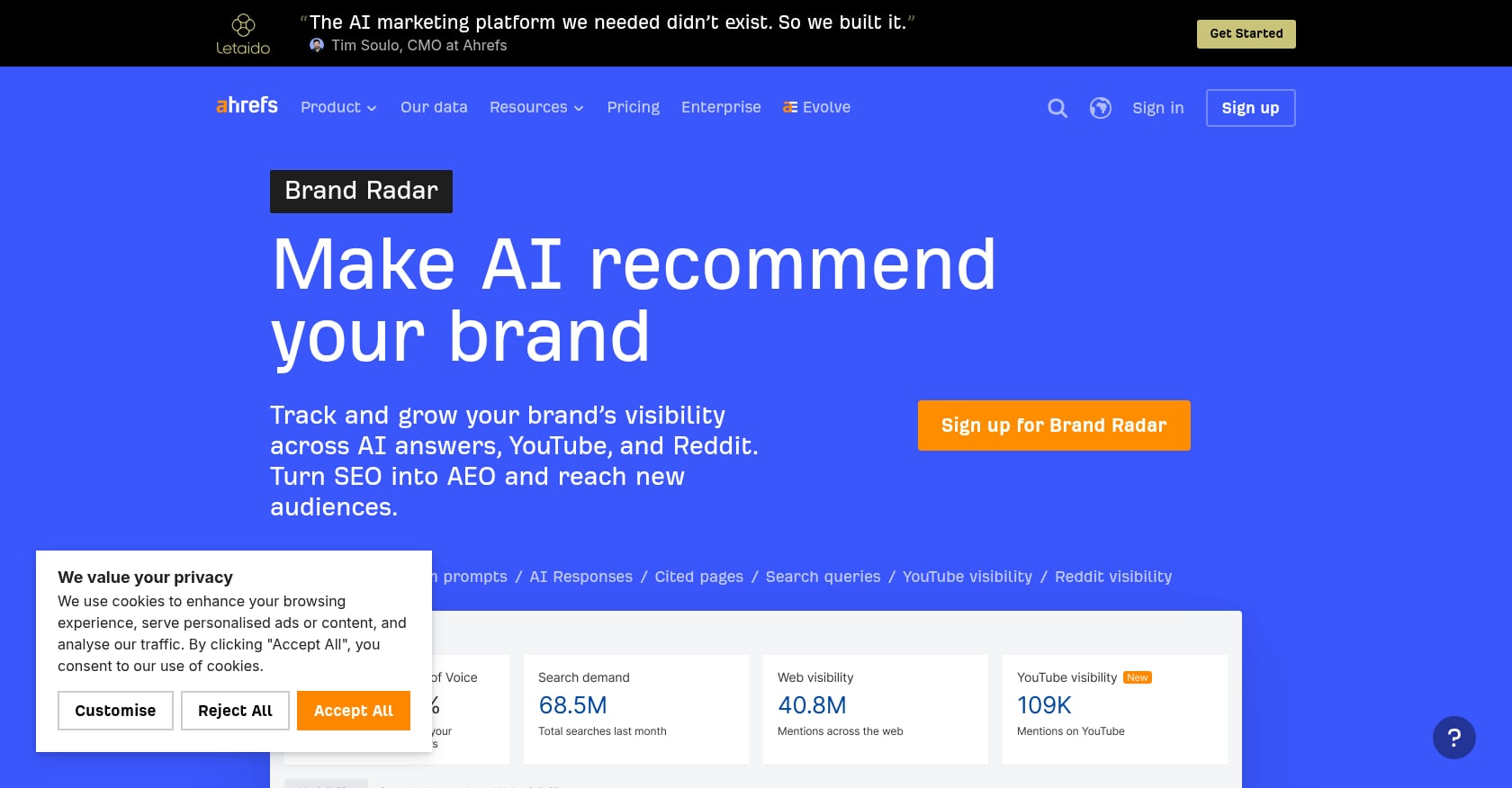
Ahrefs brings a massive prompt database of 350M+ real prompts, which provides genuine insight into what people actually ask AI engines.
Pricing:
- Requires Ahrefs subscription (starting at $699/month for plans that include Brand Radar)
Key features:
- Access to 350M+ real prompt database
- AI indexes visibility tracking
- Integration with Ahrefs’ established backlink and keyword data
Tradeoffs:
- The $699/month minimum (including base subscription) puts it out of reach for teams that don’t already pay for Ahrefs
- Some users have reported that Brand Radar underreports visibility in certain AI engines
- Not a standalone AEO tool; it’s an add-on to an SEO suite
8. HubSpot AEO
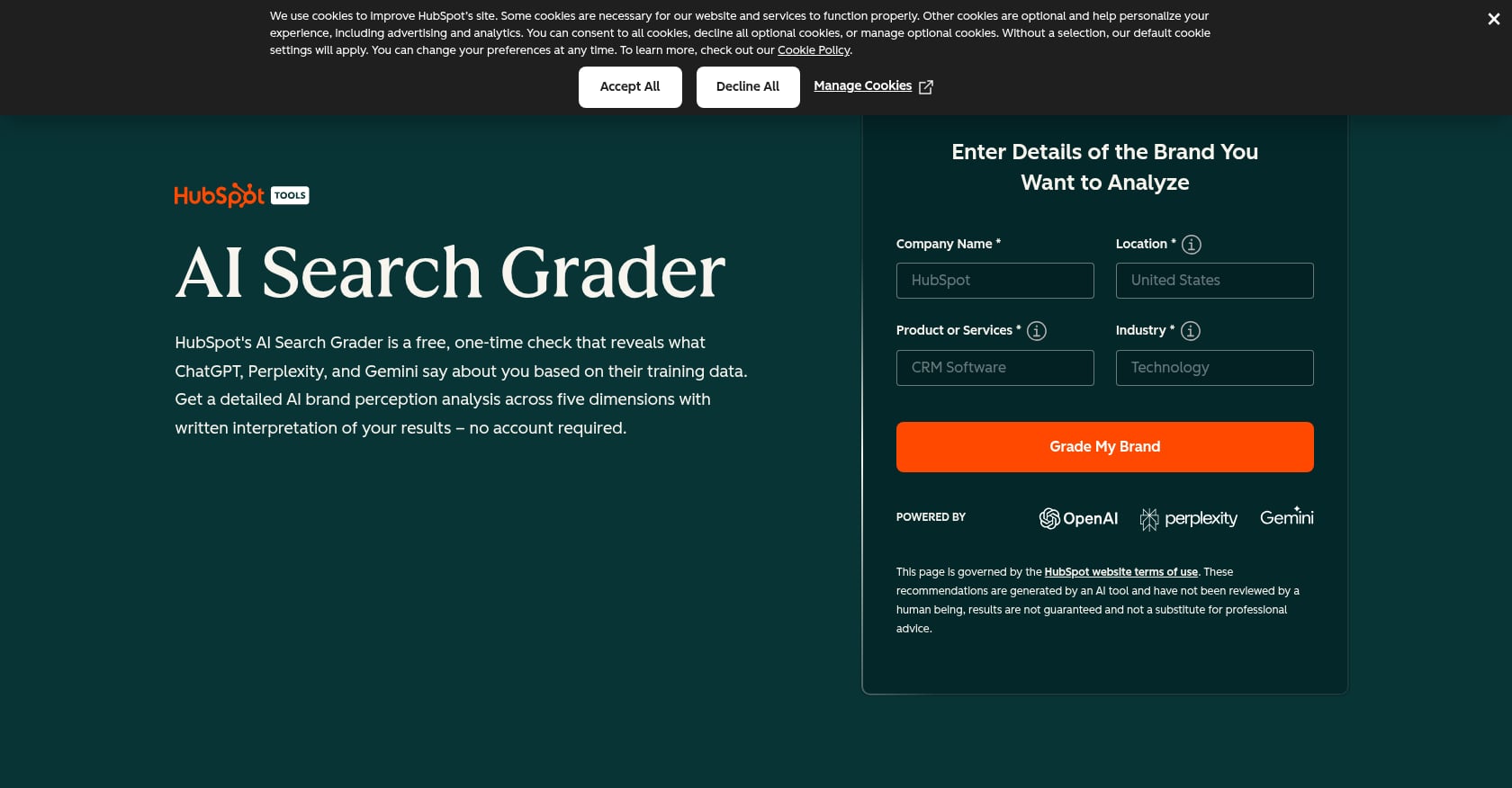
Best for: HubSpot users who want the cheapest possible entry point and don’t need broad engine coverage.
HubSpot’s AEO tool includes a free grader that needs no account, making it the lowest-friction starting point in the market. For companies already in the HubSpot ecosystem, the paid tier adds basic ongoing tracking.
Pricing:
- Free grader (no account required)
- $50/month for ongoing monitoring
Key features:
- Free AI visibility grader for instant checks
- Integration with HubSpot’s marketing platform
- Low monthly cost for basic monitoring
Tradeoffs:
- Tracks only 3 AI engines, a significant limitation when buyers use ChatGPT, Gemini, Perplexity, Claude, and AI Overviews
- Very limited depth of analysis
- Better as a starting diagnostic than an ongoing tool
9. AirOps
Best for: Content teams that need AI-driven workflow automation alongside basic AEO tracking.
AirOps sits at the intersection of content creation and visibility monitoring, making it useful for teams that produce high volumes of pages and want to track how they perform in AI answers.
Pricing:
- Custom pricing (contact vendor)
Key features:
- AI-driven content workflow automation
- Basic AEO tracking capabilities
- Template-based content creation pipelines
Tradeoffs:
- Not a dedicated AEO monitoring platform; tracking is secondary to content workflows
- Custom pricing means less transparency
- Lighter on analytics depth than purpose-built tools like Peec or Profound
10. SE Ranking (SE Visible)
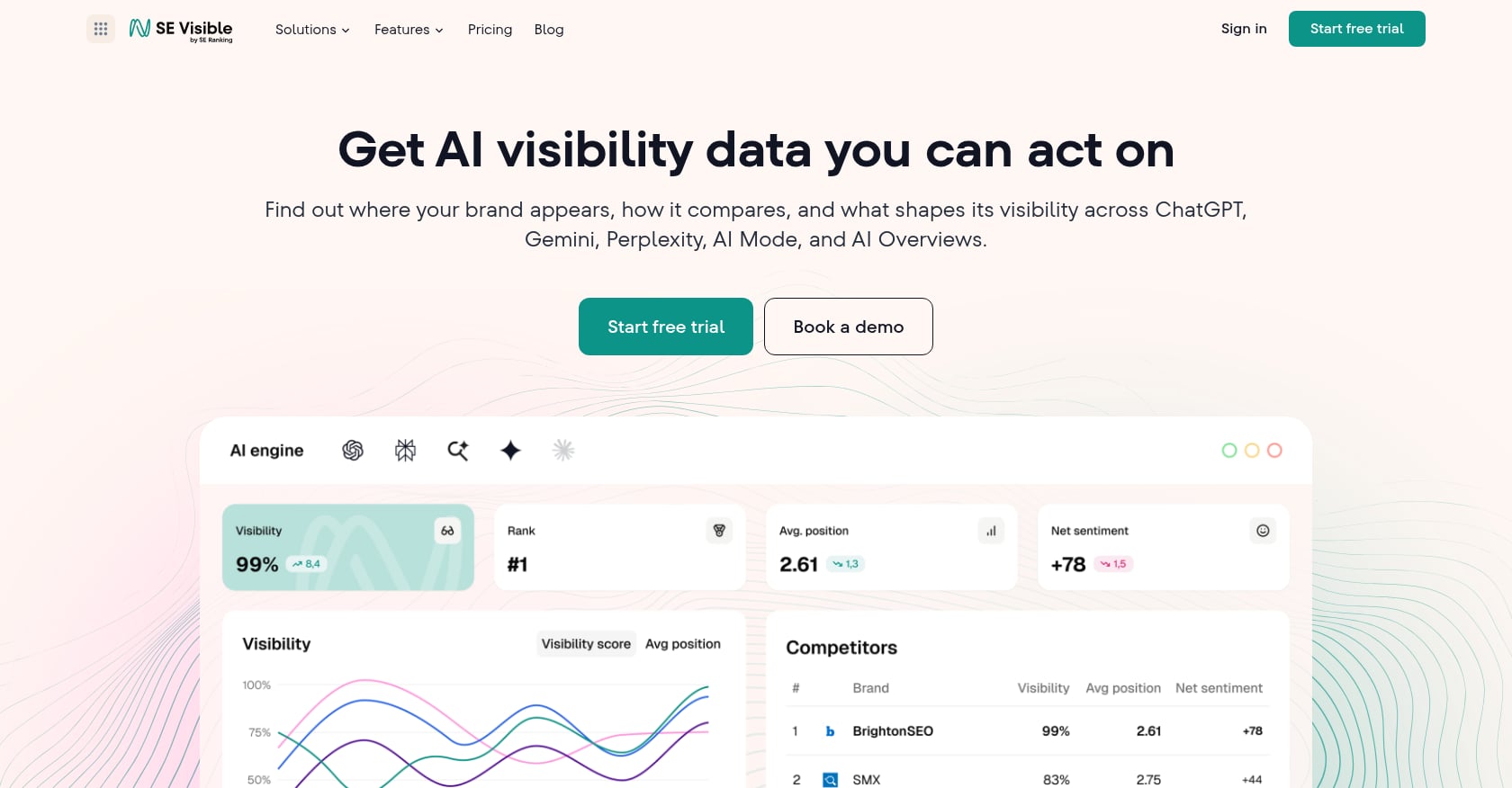
Best for: Quick, free one-off visibility checks across multiple engines.
SE Ranking publishes a free AI visibility checker covering five engines with five checks per day. It’s not a replacement for ongoing monitoring, but it’s the best free tool for spot-checking your visibility alongside HubSpot’s grader.
Pricing:
- Free tier: 5 checks/day across 5 engines
- Paid tiers available for ongoing monitoring
Key features:
- Covers 5 AI engines at the free tier
- No account required for basic checks
- Broader engine coverage than HubSpot’s free grader
Tradeoffs:
- Five checks per day is enough for curiosity, not strategy
- The free tier provides snapshots, not trends over time
- Full monitoring requires a paid plan
What Actually Gets You Cited in AI Answers
Knowing which tools exist is only half the picture. The other half is understanding what drives AI citations in the first place. For AI product companies evaluating the best answer engine optimization tool, this context determines whether a monitoring dashboard or an execution service makes more sense.
Answer-Shaped Content
The single most impactful thing: write content where a single fact or recommendation can be extracted without surrounding context. Clear headings, direct first-paragraph answers, and structured information that AI engines can grab and cite.
As Search Engine Journal warned, many AEO tools show declining citation graphs not because websites did anything wrong, but because of how the tools tracked citations: “This isn’t a measure of visibility, but a rehashed version of rank tracking, and these graphs can cost vendor contracts, incorrectly inform budget spending, and create false panic.”
The fix isn’t better tracking. It’s better content structure. Our guide on optimizing content for AI search covers the specific techniques in detail.
Schema Markup
Testing suggests LLMs ingest structured data as plain text rather than as a privileged signal. But the recommendation is still a strong yes. Traditional SEO and Google search results benefit measurably from properly implemented schema, and AI Overviews pull from Google’s index. JSON-LD, semantic schema, and entity markup help AI engines understand what your product is and what category it belongs to.
llms.txt
Today, there is no widely validated evidence that llms.txt reliably improves AEO visibility, citation frequency, or referral traffic. It likely does nothing for your odds of being cited right now. However, it’s low-cost to implement and may matter as the standard matures. Put it near the bottom of your priority list, not the top.
Third-Party Corroboration
AI engines treat certain sources as authoritative: Reddit discussions, YouTube walkthroughs, review sites like G2, and industry publications. If practitioners on Reddit are recommending your AI product, that signal feeds into the models. This is why companies building custom AI-powered applications need a presence beyond their own domain.
The Architecture Layer
These fundamentals, answer-shaped content, schema, crawlability, heading hierarchy, and third-party corroboration, are infrastructure work. Not a one-off project. They require continuous iteration as AI engines evolve, which is why the monitoring-vs-execution distinction matters so much when choosing an AEO tool for your AI product.
How to Choose the Right Option for Your AI Product
The best answer engine optimization tool for AI products depends on your stage, budget, and internal capabilities.
If you’re just starting out: Use the free tools first. HubSpot’s AEO grader and SE Ranking’s free checker give you a baseline. Ahrefs offers free single lookups. These cost nothing and take minutes.
If you need ongoing visibility data: Otterly ($29/month) or Peec AI (~$95/month) provide tracking at reasonable price points. Peec offers stronger analytics; Otterly is cheaper for low-volume monitoring.
If you’re an enterprise with dedicated teams: Profound ($499+/month) or Scrunch AI (~$300/month) provide the deepest analytics. Your in-house team handles the execution.
If you need both monitoring and execution: This is where most AI product companies actually land. You know you need to appear in AI answers. You don’t have a team that knows how to make it happen. Managed AEO services run between $2,000 and $8,000/month at most agencies. Enterprise programs can reach $10,000 to $25,000+ monthly.
Questions to Ask Any Vendor
Before signing with any AEO tool or service:
- How do you measure visibility? If they report single-run rank positions, they’re selling noise. Look for aggregate visibility percentage across many runs.
- Which engines do you actually track? Tools limited to one or two engines scored lower in every evaluation methodology reviewed for this article.
- Do you optimize, or just monitor? If the answer is “we show you where you stand,” you’ll need a separate execution plan.
- What’s the per-prompt cost at my scale? That $29/month tool might cost $489/month once you track enough prompts to make decisions.
- Can you connect citations to revenue? GA4 integration or equivalent is table stakes for proving ROI.
Warning Signs
Walk away from any vendor that guarantees specific citation placements (no one controls AI model outputs), tracks only a single engine, or won’t disclose their evaluation methodology. HubSpot’s 2026 State of Marketing data found that 58% of marketers described AI referral traffic as high intent, which means the stakes of getting this right are real, but so are the consequences of trusting bad data.
If you want to skip the trial-and-error phase and talk through what makes sense for your specific AI product, book a strategy call to get a direct assessment.
Frequently Asked Questions
What is answer engine optimization (AEO)?
Answer engine optimization is the practice of structuring your content, technical architecture, and online presence so that AI-powered answer engines (ChatGPT, Google AI Overviews, Gemini, Perplexity, Claude) cite or recommend your brand when users ask relevant questions. It’s distinct from traditional SEO, which focuses on ranking in blue-link search results.
Is AI rank tracking actually reliable?
Not at the individual query level. SparkToro’s research found that AI engines produce different brand recommendation lists more than 99% of the time for the same prompt. However, aggregate visibility percentage across many runs is reliable. The top brands in a category appeared in 55% to 77% of responses regardless of prompt phrasing. Any tool you use should measure this aggregate frequency, not single-run positions.
Do AI product companies need AEO more than other businesses?
Yes, for a specific reason: product comparison queries are among the most common AI search behaviors, and AI product buyers are disproportionately likely to start their research in AI chatbots. IDC Research projects that 79% of buyers will use AI tools to navigate complex purchasing decisions by 2028. If you sell an AI product and aren’t optimizing for AI answer engines, you’re losing deals you never knew existed.
What’s the difference between an AEO tool and an AEO service?
An AEO tool (like Profound, Peec, or Otterly) monitors whether AI engines mention your brand and provides analytics. An AEO service (like Vardha Tech’s AI Search Architecture) handles the monitoring plus the content creation, technical implementation, schema markup, and continuous optimization that actually drive citations. Most tools diagnose; services execute.
How much should I budget for AEO?
Monitoring tools range from free (HubSpot grader, SE Ranking checker) to $499+/month (Profound). Mid-market managed services typically run $2,000 to $8,000/month. Vardha Tech’s tiers start at $369/month for the Starter plan and go up to $1,989/month for the Master tier, sitting well below the industry average for full-service execution.
Does llms.txt actually help with AI visibility?
Currently, no validated evidence shows llms.txt improves AI citation frequency or referral traffic. It’s worth implementing because it’s simple and low-cost, and it may become relevant as standards evolve. But it should not be prioritized over higher-confidence work like answer-shaped content, schema markup, and third-party corroboration.
How fast can AEO produce results for my AI product?
Category positioning in AI answers tends to settle early, and brands absent when it settles face a harder path back in. Companies investing in AEO now, while the practice and the models are still evolving, have a structural advantage over those who wait. That said, no honest provider will promise a specific timeline. AI engines update their training data and retrieval patterns on their own schedules.
Can I do AEO in-house instead of using a tool or service?
Yes, if you have team members who understand schema markup, semantic HTML, LLM retrieval patterns, and can commit to continuous content iteration. The fundamentals (answer-shaped content, clear headings, entity markup, crawlability) are well-documented. The challenge is sustained execution. Most teams find they can handle an initial optimization pass but struggle with the ongoing rewrites, monitoring, and adaptation that AEO requires to maintain visibility.